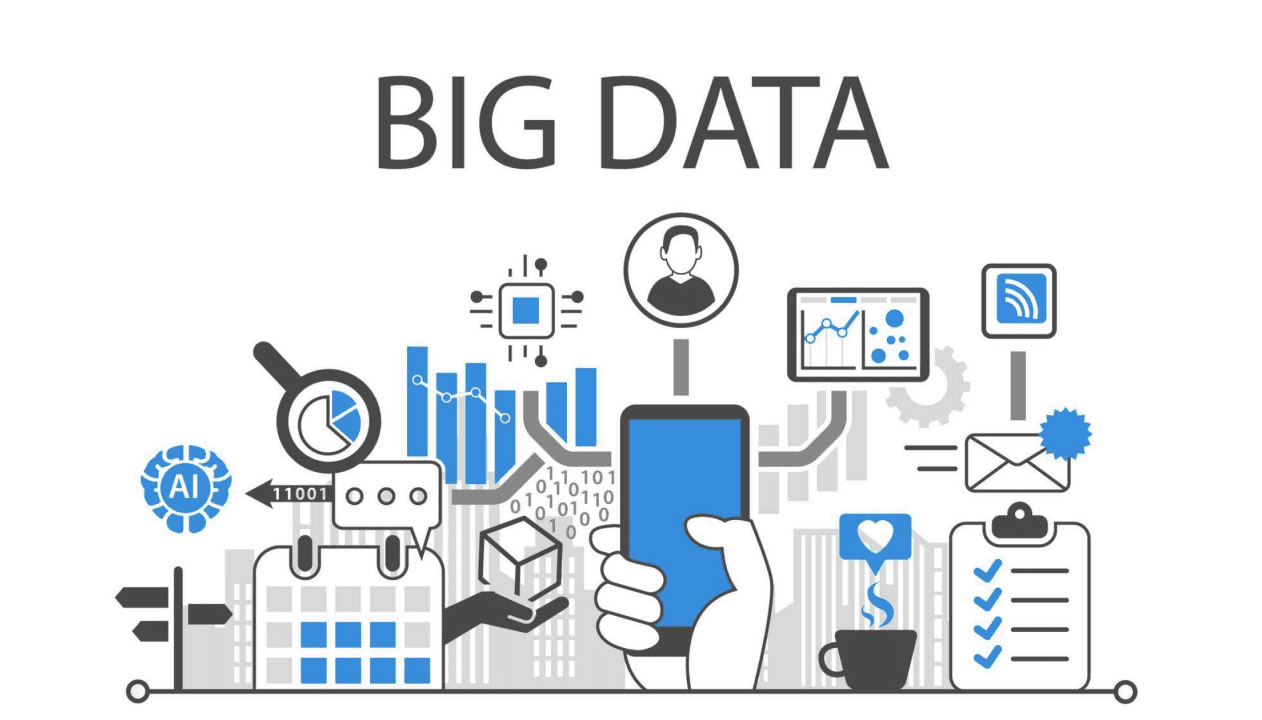
 | Big DataSyberian big data services help data professionals manage, catalog, and process raw data. Syberian offers object storage and Hadoop-based data lakes for persistence, Spark for processing, and analysis through Cloud SQL or the customer's analytical tool of choice. |
What is Big Data?
Big data defined:
What exactly is big data?
The definition of big data is data that contains greater variety, arriving in increasing volumes and with more velocity. This is also known as the three Vs.
Put simply, big data is larger, more complex data sets, especially from new data sources. These data sets are so voluminous that traditional data processing software just can’t manage them. But these massive volumes of data can be used to address business problems you wouldn’t have been able to tackle before.
The history of big data:
Although the concept of big data itself is relatively new, the origins of large data sets go back to the 1960s and ‘70s when the world of data was just getting started with the first data centers and the development of the relational database.
Around 2005, people began to realize just how much data users generated through Facebook, YouTube, and other online services. Hadoop (an open-source framework created specifically to store and analyze big data sets) was developed that same year. NoSQL also began to gain popularity during this time.
The development of open-source frameworks, such as Hadoop (and more recently, Spark) was essential for the growth of big data because they make big data easier to work with and cheaper to store. In the years since then, the volume of big data has skyrocketed. Users are still generating huge amounts of data-but it’s not just humans who are doing it.
With the advent of the Internet of Things (IoT), more objects and devices are connected to the internet, gathering data on customer usage patterns and product performance. The emergence of machine learning has produced still more data.
While big data has come far, its usefulness is only just beginning. Cloud computing has expanded big data possibilities even further. The cloud offers truly elastic scalability, where developers can simply spin up ad hoc clusters to test a subset of data. And graph databases are becoming increasingly important as well, with their ability to display massive amounts of data in a way that makes analytics fast and comprehensive.
Big data benefits:
- Big data makes it possible for you to gain more complete answers because you have more information.
- More complete answers mean more confidence in the data-which means a completely different approach to tackling problems.
How big data works?
Big data gives you new insights that open up new opportunities and business models. Getting started involves three key actions:
Integrate
Big data brings together data from many disparate sources and applications. Traditional data integration mechanisms, such as extract, transform, and load (ETL) generally aren’t up to the task. It requires new strategies and technologies to analyze big data sets at terabyte, or even petabyte, scale.
During integration, you need to bring in the data, process it, and make sure it’s formatted and available in a form that your business analysts can get started with.
Manage
Big data requires storage. Your storage solution can be in the cloud, on premises, or both. You can store your data in any form you want and bring your desired processing requirements and necessary process engines to those data sets on an on-demand basis. Many people choose their storage solution according to where their data is currently residing. The cloud is gradually gaining popularity because it supports your current compute requirements and enables you to spin up resources as needed.
Analyze
Your investment in big data pays off when you analyze and act on your data. Get new clarity with a visual analysis of your varied data sets. Explore the data further to make new discoveries. Share your findings with others. Build data models with machine learning and artificial intelligence. Put your data to work.
Syberian Big Data Products
Syberian Cloud Infrastructure Data Flow Syberian Big Data Service Syberian Cloud Infrastructure Data Catalog | Simplify big data application delivery with Apache SparkSyberian Cloud Infrastructure Data Flow is a fully managed Apache Spark service with no infrastructure for customer IT teams to deploy or manage. Data Flow lets developers deliver applications faster because they can focus on application development without getting distracted by operations. Make it easier to build managed data lakesSyberian Big Data Service is a Hadoop-based data lake to store and analyze large amounts of raw customer data. A managed service, Syberian Big Data Service comes with a fully integrated stack that includes both open source and Syberian value-added tools that simplify your IT operations. Syberian Big Data Service makes it easier for enterprises to manage, structure, and extract value from organization-wide data. Enable self-service data discovery and governanceSyberian Cloud Infrastructure Data Catalog helps data professionals across the organization search, explore, and govern data using an inventory of enterprise-wide data assets. It automatically harvests metadata across an organization’s data stores and provides a common metastore for data lakes. Data Catalog simplifies the definition of business glossaries and curated information about data assets located in Syberian Cloud Infrastructure and other locations so data consumers can easily find needed data. |
Bring all your data together with a data lake
Complete, integrated solution
Deploy a complete, integrated solution, including data management, data integration, and data science, so analytics teams can maximize the value of enterprise data. Customers ingest any data via batch, streaming, or real-time processes and store it in data warehouses or data lakes as needed. Teams then catalog and apply governance to the data so they can use it for analyses, visualizations, and machine learning models. IT teams leverage consistent security policies across data warehouses and data lakes.
Deploy in Syberian Cloud data centers
Deploy Syberian big data services wherever needed to satisfy customer data residency and latency requirements. Big data services, along with all other Syberian Cloud Infrastructure services, can be utilized by customers in the Syberian public cloud, or deployed in customer data centers as part of an Syberian Dedicated Region Cloud at Customer environment.
Easy to manage and operate
Increase developer productivity with a fully managed, serverless, Apache Spark cluster that is accessible via APIs. Each cluster is automatically provisioned, secured, and shut down to reduce developer workloads. Customers can deploy fully managed Hadoop clusters of any size or shape, then add security and high availability with a single click.